
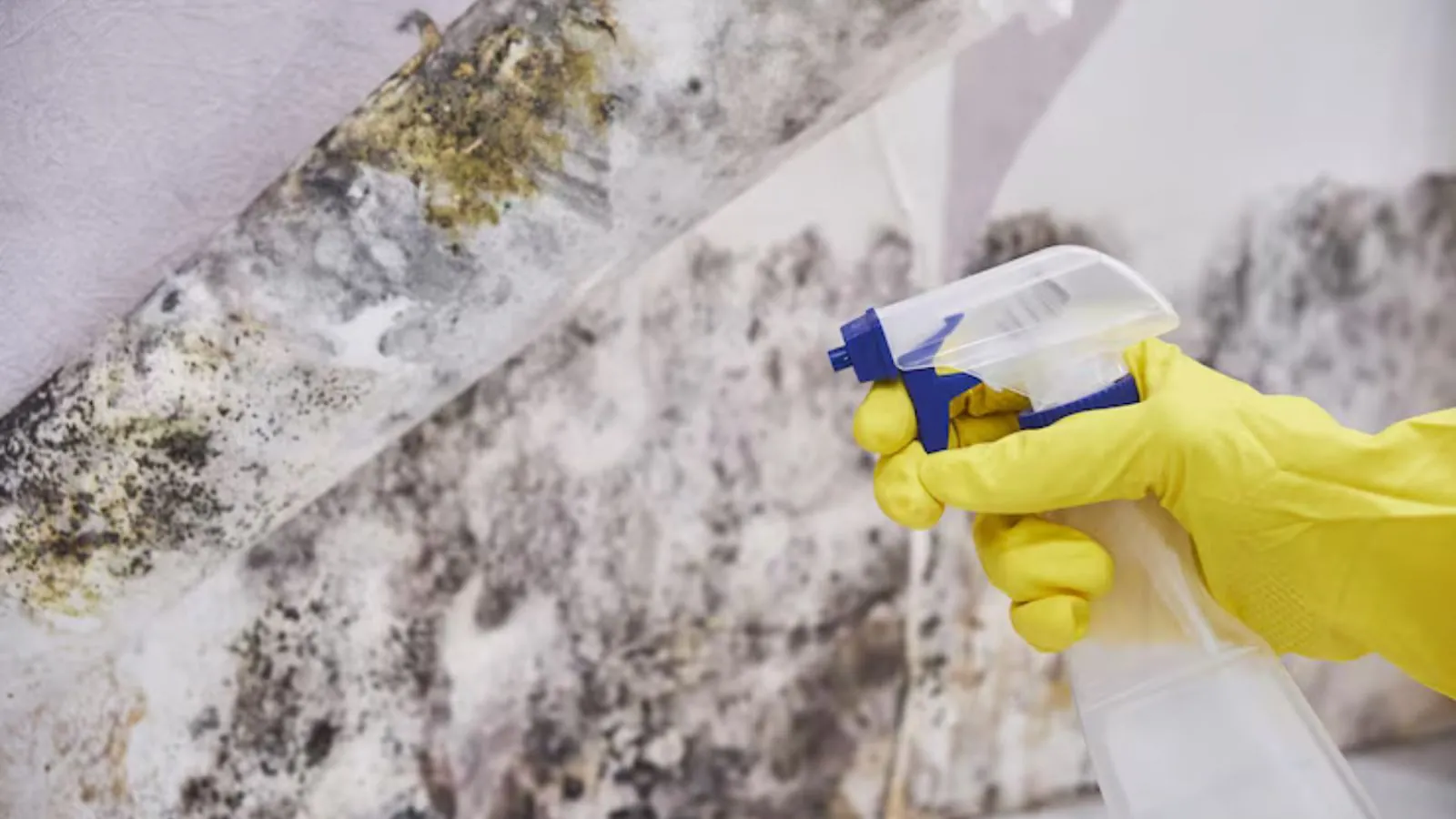
People search for black mold because the phrase sounds alarming. Here is the calmer truth: you cannot identify a mold, or judge its risk, by its color. Many common indoor molds are dark. What decides the right response is how much there is, where it is and why it is growing.
This guide explains what to do when you find dark mold at home. It is not medical advice. Questions about symptoms belong with your physician.
What black mold usually is
The term is often used for one species, Stachybotrys chartarum, a dark greenish-black mold that grows on materials with a lot of cellulose, such as the paper face of drywall, after they have been wet for a long time. But plenty of other molds are black or dark gray, including very common ones found on window frames and bathroom caulk.
You cannot tell them apart by looking. And from a removal point of view it does not change much. Public health agencies give the same advice for all indoor mold growth: remove it and fix the moisture.
Where dark mold turns up
- Common spots after water damage
- The bottom of drywall in a basement that flooded or stayed damp.
- Behind baseboards and under carpet pad after a slow leak.
- Inside sink cabinets and behind dishwashers.
- On ceilings below a bathroom or a roof leak.
- Around air conditioner drain pans and on nearby drywall.
The pattern is always the same: a material that stayed wet. Find the water and you have found the reason.
Wisconsin's official position on testing
Before paying for a test, read what the Wisconsin Department of Health Services says. Its guidance is that mold testing is generally not necessary. If you can see mold or smell it, you already know there is a problem, and no test changes what has to be done about it.
The department also states that Wisconsin does not certify or license mold inspectors or remediation contractors. In Oak Creek, as anywhere in the state, the word certified on a van is not a state credential. Ask instead how the work area will be contained and which standard the crew follows.
Where a test is required, for example by a buyer or a landlord, the state's advice is to keep the tester independent of the company doing the removal.
Source: Wisconsin Department of Health Services mold guidance.
What you can clean yourself
The U.S. Environmental Protection Agency uses a size guide. A moldy area of less than about 10 square feet, roughly 3 feet by 3 feet, can usually be handled by the homeowner. That applies to hard surfaces such as tile, sealed wood or glass.
Wear gloves, eye protection and a well-fitted N95 respirator. Scrub with detergent and water and dry the surface completely. Do not mix cleaning products. Absorbent materials, such as ceiling tiles and carpet, may have to be thrown away, because mold grows into them.
Two rules from the same guidance: do not paint or caulk over mold, and fix the leak first or it will be back.
When to bring in a professional
| Situation | Why it needs more than a sponge |
|---|---|
| More than about 10 square feet | Disturbing a large area releases a lot of spores without containment |
| Mold inside walls, ceilings or under floors | Materials have to be opened and removed safely |
| Growth in the heating or cooling system | Running the system spreads it. The EPA says not to run it |
| Mold after sewage or flood water | The contamination is more than mold |
| Anyone in the home with a health concern | Ask a health professional before starting cleanup |
Professional removal uses plastic containment, negative air pressure and HEPA filtration so spores are not spread to clean rooms. Our mold remediation page describes each step.
Why it comes back
Mold that returns after cleaning was never the real problem. Moisture was. If the drywall is still damp, or the basement humidity stays high, new growth appears on the cleaned surface in weeks.
The EPA's humidity guidance is to stay below 60 percent, ideally between 30 and 50. A basement dehumidifier and a cheap humidity gauge do a lot. If the damp follows a leak, the structure may need proper drying, which is covered under structural drying.
We handle mold that follows water damage in Oak Creek and nearby, including Muskego and Franklin.
What not to do
Do not spray bleach on drywall and call it done. Bleach lightens the stain on the surface and adds water to a porous material. Do not set up a fan pointing at visible mold, which spreads spores. Do not rip out moldy drywall in an open room with the furnace running.
And do not panic over the color. Focus on the size, the location and the moisture.