
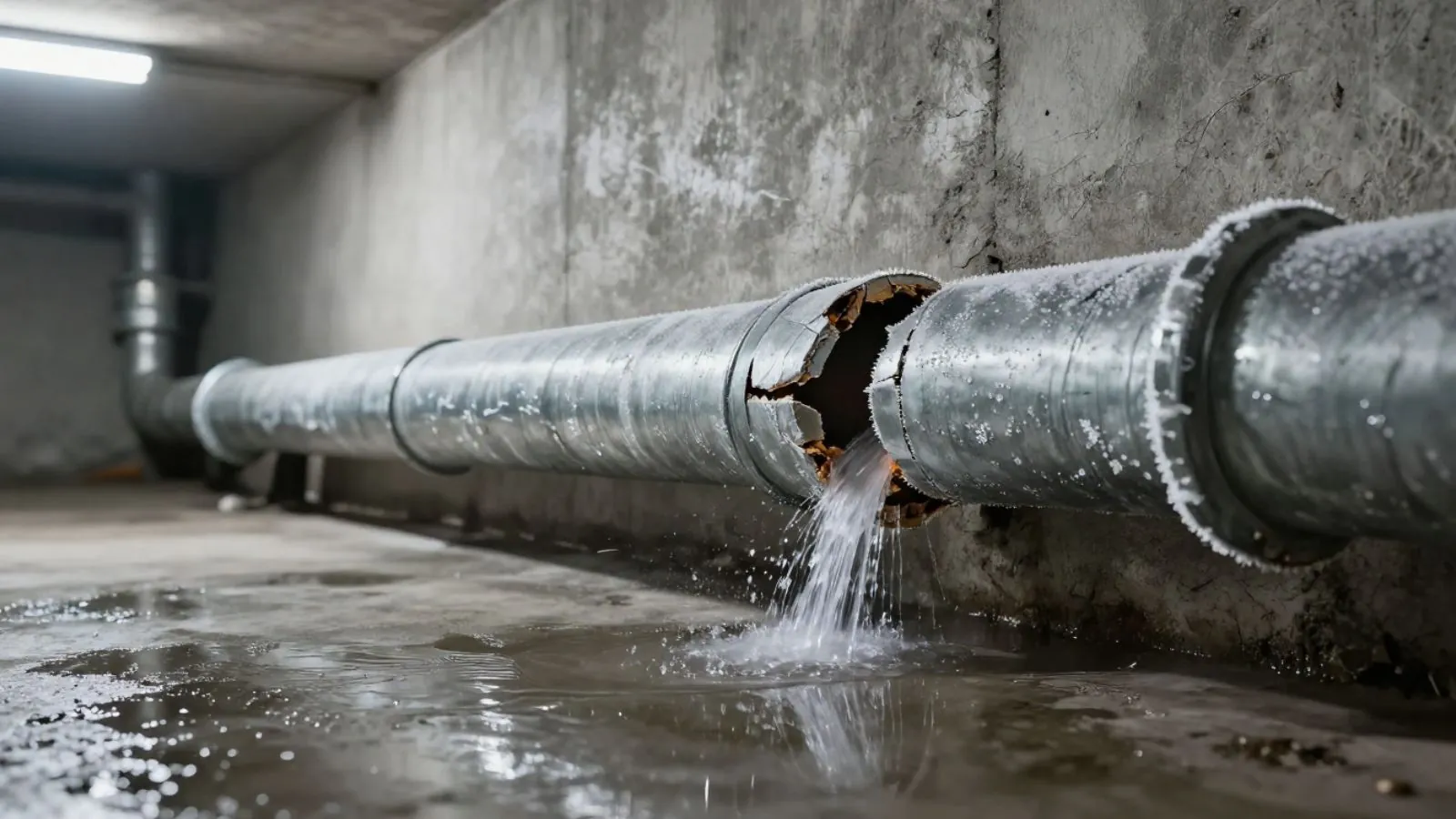
A pipe that froze overnight is urgent the moment it thaws, and we answer the phone 24/7. Frozen pipe water damage restoration in Oak Creek, WI deals with the water released when ice splits a line and then melts. If a tap has slowed to a trickle or a wall feels icy, close the main valve now and open the taps, before the thaw does the damage for you.
Ice expands inside the pipe and pressure builds between the blockage and the closed tap. The pipe cracks while frozen but cannot leak. The flood starts hours later, often while the house is empty or everyone is asleep.
Frozen pipe emergency: thawing without a flood
- If you suspect a frozen line
- Close the main water valve before you apply any heat.
- Open the affected tap so melting water has somewhere to go.
- Warm the pipe gently with a hair dryer or warm towels, starting at the tap end.
- Never use a torch, a heat gun on plastic pipe, or any open flame.
- Look along the pipe for a split or a bulge. If you see one, leave the valve closed and call a plumber.
If water is already coming through a ceiling or wall, skip the thawing and call. The priority is now the water, not the ice.
How cold it gets here, in numbers
The 1991 to 2020 climate normals for Milwaukee, measured at the airport on Oak Creek's border, show an average January low of 17.2 degrees and 48.7 inches of snow in a normal year. Water in an exposed pipe starts to freeze well above that temperature once the cold has a few hours to work.
We do not have a published count of how often pipes freeze in Oak Creek, so we will not invent one. What we can say is where it happens when it does: lines in exterior walls, over unheated garages, in rim joists and in vacation-empty homes with the heat turned down. If any of those describe your house, pipe insulation and a thermostat set no lower than the mid 50s are sensible precautions.
What the water damages
Frozen pipe breaks are usually in outside walls and ceilings, which are full of insulation. Wet fiberglass slumps and holds water against cold framing, and it cannot be dried in the cavity. It comes out.
Below the break, water follows the usual route into walls and drywall and across flooring. If the line ran above a finished room, expect ceiling damage as well. A thermal camera is especially useful in winter, because wet areas stand out sharply against a cold wall.
Drying a house in January
Cold weather changes the drying plan. Outside air is dry but frigid, so we keep the house closed and heated and let LGR dehumidifiers do the work. Air movers push warm air into opened cavities. Readings are logged until the framing matches dry wood elsewhere in the home.
New insulation goes back only after the cavity is dry. Closing a wall over damp studs in winter is how hidden mold starts. If the leak went unnoticed for days while the house was empty, mold remediation may be part of the scope.
Our crews cover Oak Creek and nearby towns, including the well-served streets of Hales Corners.
What decides the cost after a frozen pipe
| Cost factor | Why it matters on this job |
|---|---|
| How long it leaked | A break caught at breakfast is small. One found after a week away is a large loss. |
| Insulation removal | Exterior wall and attic breaks mean wet insulation to remove and replace. |
| Number of breaks | A hard freeze can split a line in two or three places along the same run. |
| Heating during drying | Winter drying needs the building warm, with dehumidifiers running for days. |
| Rebuild | Drywall, insulation, paint and flooring. |
Freeze damage is often covered when the home was occupied and heated, and often disputed when it was left unheated. That is a policy question, so ask your insurer. We document the break location, the rooms affected and the readings.
Want your real number? Call (833) 521-1033. We serve Oak Creek, Franklin, Greendale, Hales Corners, Franksville and Muskego. Work is done to the ANSI/IICRC S500 standard.