
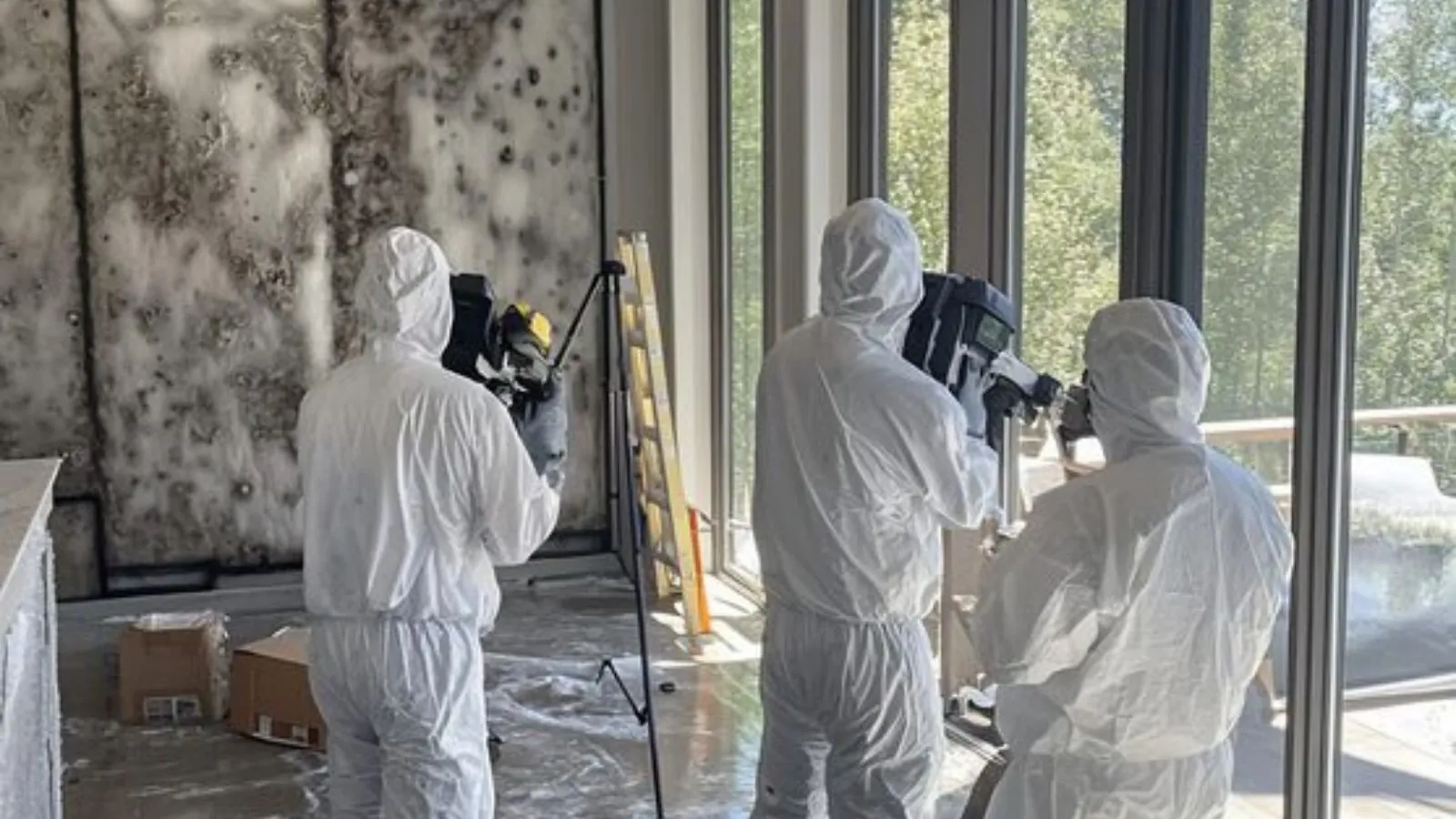
Mold remediation in Oak Creek, WI is the contained removal of mold growth from a building and the correction of the moisture that allowed it. Mold remediation follows ANSI/IICRC S520, the published standard for the work, and it is always a moisture job first. Remove mold without fixing the damp and it comes back.
This is a secondary service for us. Most of the mold we handle follows a leak, a wet basement or a slow drip that went unnoticed.
Is that musty smell or dark spotting mold?
Probably, if it follows water. People describe a musty or earthy smell in a basement or closet, dark specks on drywall near the floor, fuzzy growth on stored cardboard, or stains that return through paint. The EPA notes that a moldy smell with no visible source suggests hidden growth.
The trade name for dealing with it properly is mold remediation. The word means more than cleaning: it includes containing the area so spores do not spread, removing affected materials and fixing the moisture.
Inspection and testing: what you actually need
Many callers ask for a mold test first. Here is what Wisconsin's Department of Health Services says: testing is generally not necessary. If you can see or smell mold, you have a mold problem, and the money is better spent on finding the moisture and removing the growth.
What you do need is an inspection. We look at the visible growth, trace the moisture with a meter and a thermal imaging camera, and work out how far it extends behind surfaces. You get the scope and price explained before work starts.
Testing has its place. A buyer, lender or landlord sometimes requires a report, or an occupant wants a clearance test afterwards. The state's advice is that the person who tests should be independent of the company doing the removal. We agree, and we do not sell testing.
Small enough to handle yourself?
The EPA's rule of thumb is about 10 square feet, roughly a 3 foot by 3 foot patch. Below that, on a hard surface, a careful homeowner can usually clean it. Above that, or when it is inside walls, in the HVAC system or follows contaminated water, bring in help.
Two cautions from the same guidance: do not run the heating or cooling system if you suspect it is contaminated, and do not paint or caulk over mold. Porous materials such as ceiling tiles and carpet may have to be thrown away once moldy.
How remediation is done
The work area is sealed with plastic sheeting and put under negative air pressure with a HEPA-filtered machine, so air flows in and not out. Technicians wear respirators and protective suits.
Moldy drywall, insulation and other porous materials are cut out, bagged and removed. Framing and other solid surfaces are cleaned by HEPA vacuuming and damp wiping, and sanded or brushed where growth is rooted in the wood. Then the area is dried to a normal reading.
The moisture source is corrected at the same visit or flagged for the right trade. Typical sources are covered on our basement water damage, crawl space and AC leak pages.
Licensing and honesty
Wisconsin does not certify or license mold inspectors or remediation contractors. The state health department says so directly. Anyone can use the title, so ask how the work will be contained and what standard it follows. Our crews are licensed and insured and work to S520.
We do not diagnose health effects or promise that mold will never return. Questions about symptoms belong with your physician. We serve Oak Creek and nearby towns, including Muskego.
What decides the cost of mold remediation
| Cost factor | Why it matters on this job |
|---|---|
| Area affected | A patch behind a baseboard, a wall, or a whole basement. |
| Location | Open surfaces are simple. Wall cavities, attics and crawl spaces take longer. |
| Materials | Drywall and insulation are removed. Framing is cleaned in place. |
| Containment | Sheeting, negative air and HEPA filtration sized to the area. |
| Moisture correction | Drying and repairs to stop it returning. |
Mold coverage is limited or excluded in many policies, and often depends on whether a covered water loss caused it. Check your policy or ask your insurer. We document the growth, the moisture source and the materials removed.
Want your real number? Call (833) 521-1033. We serve Oak Creek, Franklin, Greendale, Hales Corners, Franksville and Muskego. Work is done to the ANSI/IICRC S500 standard.