
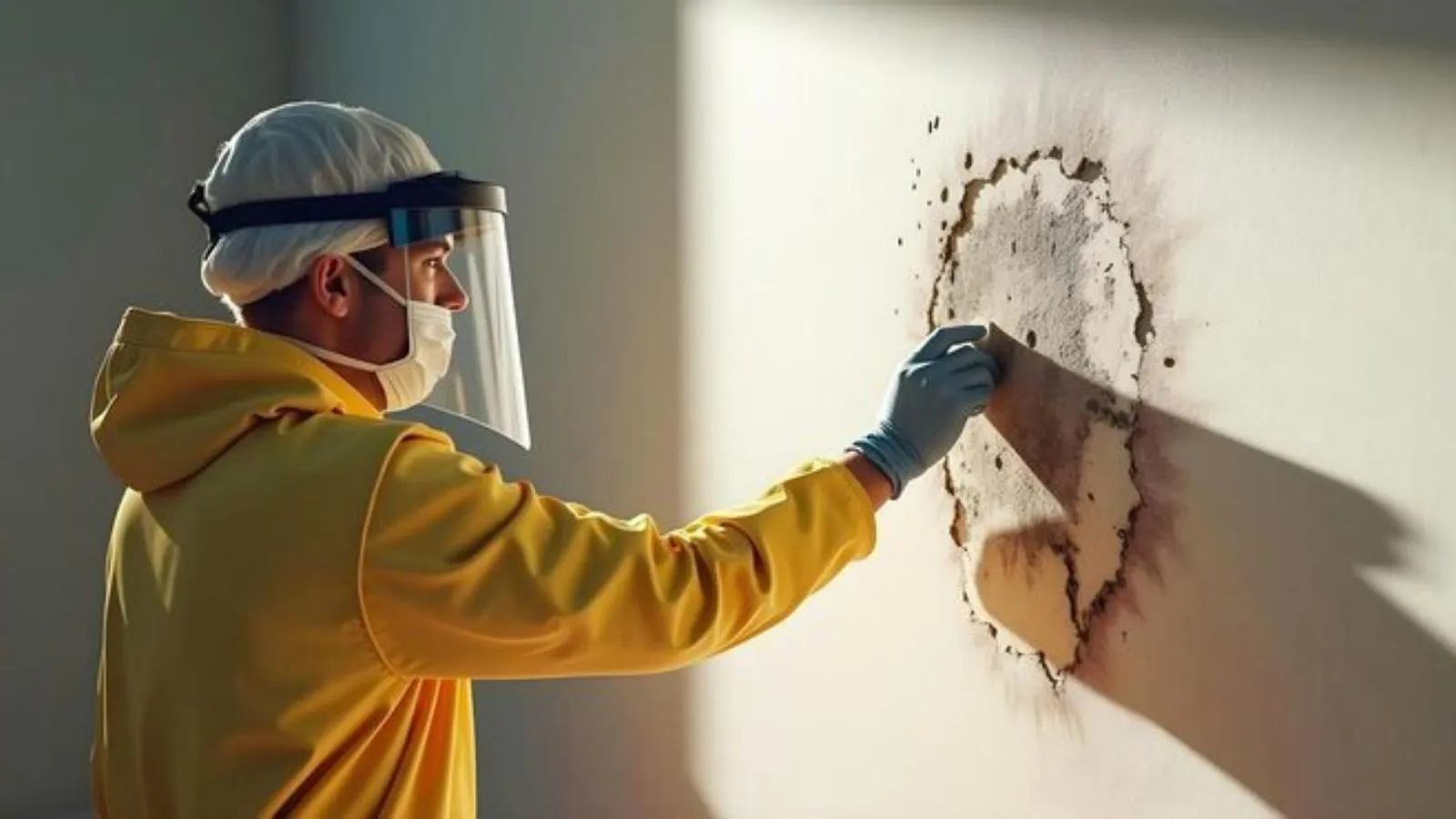
Small amounts of mold are a normal household job, like cleaning an oven. You do not need a contractor for a patch of mildew on a bathroom ceiling or a little growth on a basement window frame. You do need to do it properly.
This guide covers small clean ups on hard surfaces. It is general information, not medical advice. If anyone in the home has asthma, allergies or a weakened immune system, ask a health professional before you start.
First, measure it
The U.S. Environmental Protection Agency draws the line at about 10 square feet, a patch roughly 3 feet by 3 feet. Under that, on a hard surface, you can usually do it yourself. Over that, or if the water that caused it was sewage or flood water, the agency recommends following its professional remediation guidance or hiring help.
Measure honestly. Mold on the visible face of drywall often continues on the back. If the wall is soft or the patch keeps growing, treat it as larger than it looks.
What to wear
- Basic protection
- An N95 respirator, fitted snugly. A dust mask is not enough.
- Gloves that reach the mid forearm.
- Goggles without ventilation holes.
- Old clothes you can wash hot straight afterwards.
Open a window if weather allows and close the door to the rest of the house. Turn off the furnace or air conditioner fan while you work so it does not carry spores around.
The method
Scrub hard surfaces with detergent and water. That is the EPA's advice, and it is enough. You do not need special mold products for a small patch. Rinse, then dry the surface completely with towels and airflow.
Bag the rags and sponges, tie the bag and put it out with the trash. Wipe down nearby surfaces with a damp cloth to collect settled dust. Wash your clothes.
Never mix bleach with ammonia or other cleaners. If you choose to use a disinfectant, follow the label and ventilate the room.
What to throw away
| Material | Clean or discard |
|---|---|
| Tile, glass, metal, sealed wood | Clean and dry |
| Painted drywall with surface spots only | Clean and dry, watch for return |
| Drywall that is soft or moldy through | Cut out and discard |
| Ceiling tiles | Discard |
| Carpet and pad with visible growth | Usually discard |
| Cardboard boxes and paper | Discard |
| Washable fabrics | Wash hot and dry fully |
The EPA's wording is that absorbent or porous materials may have to be thrown away if they become moldy, because mold grows into the pores and cannot be fully removed.
Oak Creek specifics: humidity, basements and state advice
Local climate explains a lot of household mold here. The climate normals for Milwaukee, measured at the airport on Oak Creek's border, show June as the wettest month, and summer air from Lake Michigan is humid. Cool basement walls and humid air produce condensation, and condensation feeds mold.
The practical step is a humidity gauge, which costs little. The EPA's target is under 60 percent relative humidity, ideally 30 to 50. If your basement reads above that in July, a dehumidifier is the fix, not more cleaning.
The Wisconsin Department of Health Services adds that testing is generally not necessary when you can see or smell mold. Spend the effort on cleaning and on the moisture.
Sources: Wisconsin State Climatology Office, U.S. Environmental Protection Agency, Wisconsin Department of Health Services.
Fix the moisture or do it all again
Cleaning is half the job. Mold returns to any surface that stays damp. Find the reason: a bathroom fan that does not vent outside, a dripping pipe, a gutter that dumps water against the foundation, a dryer vent that has come loose.
If the mold followed a leak or a wet basement, the materials themselves may still be holding water. That is a drying problem, described under structural drying. Recurring damp at the base of walls is covered under wall and drywall repair.
When to stop and call
Stop if the patch turns out to be larger than you thought, if the drywall crumbles, if you find growth inside a wall cavity or if you smell mold but cannot find it. The EPA notes that a moldy smell with no visible source suggests hidden growth.
Stop also if the heating or cooling system might be involved. The agency's advice is not to run a system you suspect is contaminated. At that point it is a job for containment and proper equipment, described on our mold remediation page.
We inspect and remove mold in Oak Creek and nearby towns, including Franklin and Muskego.