
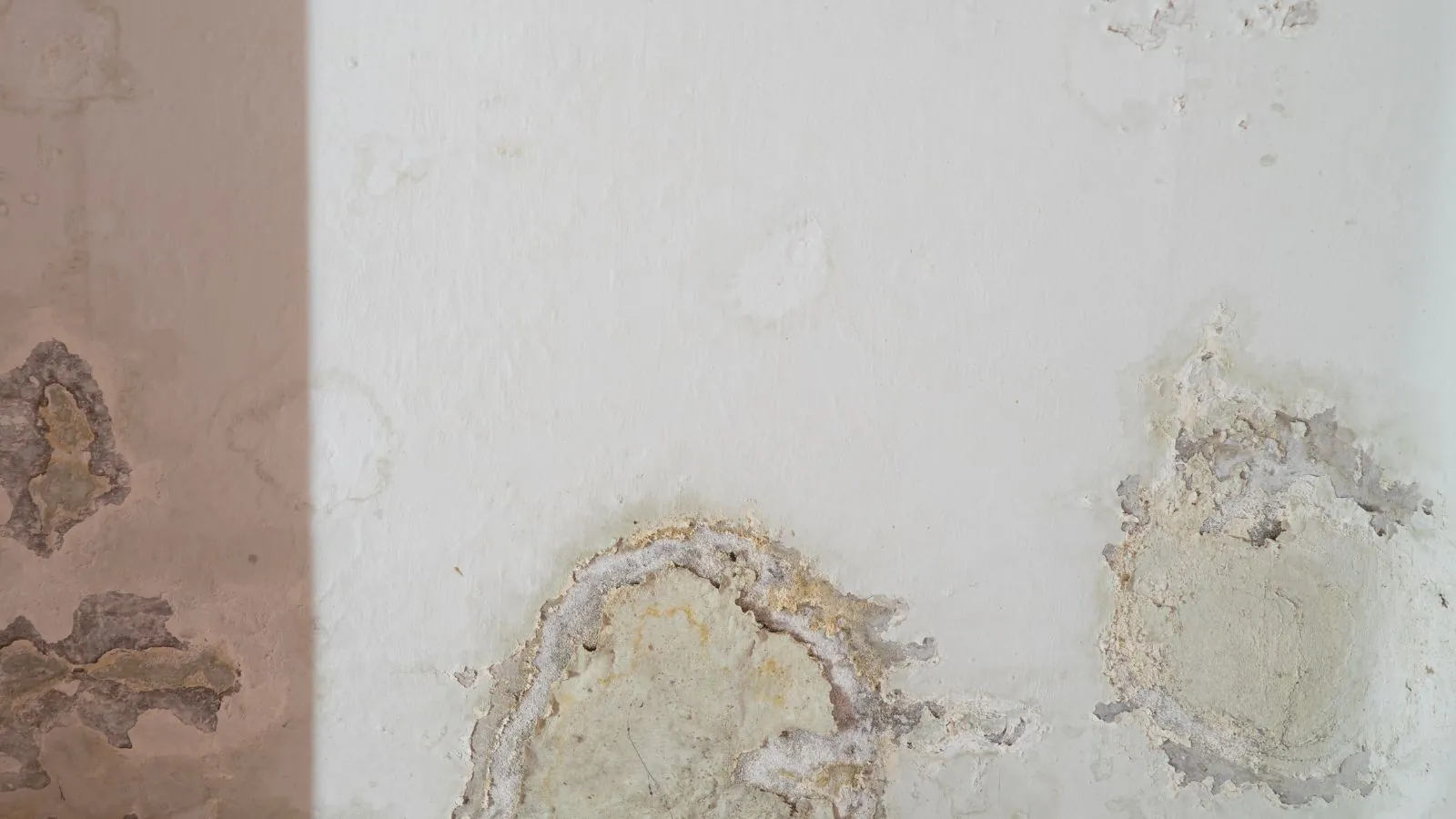
You have found a stain. Maybe you just moved in, or moved a piece of furniture, or looked up for the first time in a while. The question is whether it is a leak happening now or the mark of something that was fixed years ago.
It matters for three reasons: whether you need to act today, what it will cost, and what an insurer will say. Here is how to read the signs.
Six clues
| Clue | Points to new | Points to old |
|---|---|---|
| Touch | Damp, cool or soft but intact | Dry and hard, or dry and crumbly |
| Rings | One patch, darker at the edge, no rings | Several rings, like a tree stump |
| Color | Darker and uniform while wet | Yellow-brown, faded, sharp outline |
| Surface | Paint intact or just starting to bubble | Paint peeled, flaking, chalky |
| Mold or rot | None yet | Spots, a musty smell, soft wood |
| Change over days | Growing or changing shape | Exactly the same |
No single clue is proof. Three or four pointing the same way usually are.
Reading the rings
Rings are the most useful sign. Each time a material gets wet and dries, minerals and dirt in the water are left at the edge of the wet patch. One event leaves one outline. A leak that comes and goes, such as a roof that only drips in heavy rain, leaves a ring for each episode.
So multiple rings tell you two things: the problem is old, and it is recurring. That is not good news about the cause, even if the stain is dry today.
The touch test
Press the stained area gently with a fingertip. New damage in drywall feels damp or cool and gives slightly. Old damage that dried is hard, sometimes with a brittle, chalky surface.
Be careful with ceilings. If the area sags or feels heavy, do not press. Water may be sitting on top of it. Also note that some materials stay firm when wet. Plaster, tile and thick paint hide moisture well, so touch alone can mislead.
What mold and rot tell you
Mold needs time. The U.S. Environmental Protection Agency's guidance is to dry things in the first 24 to 48 hours to prevent it, and visible growth usually takes longer than that to appear. So spots of mold on a stain mean the material has been wet for a while, or has been wet repeatedly.
Soft, crumbling wood is older still. Wood does not rot in a week. If a window sill, subfloor or joist is punky, the moisture has been there for months or years.
Watch it for a week
- A simple monitoring method
- Trace the outline lightly in pencil and write the date beside it.
- Take a photo with something in the frame for scale.
- Check after rain, after showers upstairs and after running appliances.
- If the patch crosses the pencil line, it is active.
- Note what was happening when it grew. That points to the source.
A stain that grows after rain suggests the roof or an outside wall. One that grows after a shower suggests plumbing above. One that grows only in summer, near the indoor cooling unit, suggests the air conditioner's drain.
Local clues in Oak Creek homes
The house itself gives context. Oak Creek had 11,897 housing units in 2000 and 15,620 in 2020, so roughly a quarter of the city's homes went up after the turn of the century. In a house that new, a multi-ring stain has not had long to form and deserves a hard look at the plumbing above it.
Dates help too. If a stain appeared in mid August 2025, the cause is not much of a mystery. The weather station at the airport on the city's border recorded 5.74 inches of rain on August 9 of that year. Ask the previous owner or check your own photos from that month.
For hidden plumbing leaks, the Oak Creek Water and Sewer Utility describes a meter test. Turn off every tap and appliance and watch the small red dial on the water meter. If it moves, water is escaping somewhere. Check again after 30 minutes for slow leaks. A still dial and a stain that grows only when it rains point away from plumbing and toward the building's exterior.
Sources: U.S. Census counts as compiled by the Encyclopedia of Milwaukee, Wisconsin State Climatology Office, City of Oak Creek Water and Sewer Utility.
The definite answer: a moisture meter
All of the above is inference. A moisture meter measures. It reads the water content of drywall, wood or plaster and compares it with a dry area of the same material. A wet reading means the leak is active or very recent. A dry reading means the stain is history.
A thermal imaging camera adds the picture: wet areas are cooler and show up clearly, including areas that are wet but not yet stained. Together they show the true extent, which is usually larger than the mark.
Why insurers care
Policies generally cover sudden and accidental water damage and exclude damage that happened gradually. Rings, rot and mold are how an adjuster tells one from the other. If you find a stain, photograph it straight away with the date, before anything changes.
Coverage depends on your policy and the cause, so ask your insurer. We document what we find without judging coverage.
What to do next
If the signs say new: find and stop the source, then get the materials dried. If they say old and dry: find out whether the cause was ever fixed before you paint. If you cannot tell: have it measured.
Ceiling stains are explained on our ceiling water damage repair page, and stains on walls under wall and drywall repair. We inspect homes across Oak Creek and nearby towns, including Muskego and Hales Corners.